The Hidden UEDCL Tax Kampala Families Pay Every Month
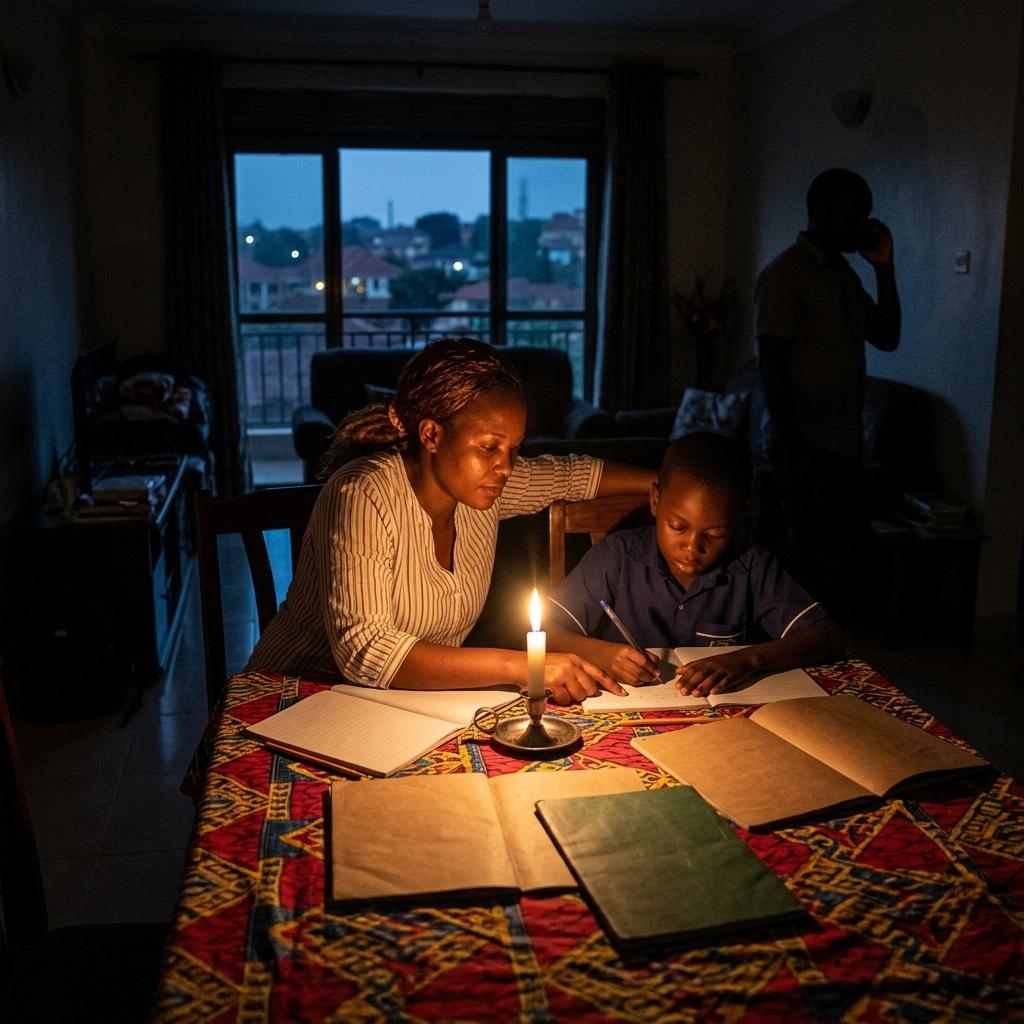
It is 7:42 in the evening in Ntinda. A mother leans over her son's Primary 4 mathematics exercise book by the light of a single wax candle. Her husband is on the balcony, phone pressed to his ear, trying to persuade a client that a delayed invoice is not his fault — it is UEDCL's fault. Outside, the neighbourhood is dark except for the distant, steady hum of a neighbour's generator.
This scene repeats itself across Kampala four, five, sometimes seven nights a week. Most households treat it as weather. They should treat it as a monthly tax.
The bill nobody voted for
UEDCL took over distribution from UMEME on 1 April 2025, and in many Kampala corridors outages have become longer and more predictable. Scheduled load shedding now routinely lasts four to eight hours in residential areas; unscheduled drops push that beyond ten.
Every outage hour has a price. A conservative accounting for a four-person Kampala household looks like this:
| Line item | Typical monthly spend |
|---|---|
| Wax candles (30 × UGX 500) | UGX 15,000 |
| Kiosk phone charging (8 charges × UGX 1,000) | UGX 8,000 |
| Generator fuel (0.8 kVA, ~40 L × UGX 5,200) | UGX 208,000 |
| Spoiled food (1 fridge-load / quarter, amortised) | UGX 25,000 |
| Appliance voltage damage (amortised) | UGX 45,000 |
| Generator-owning household total | |
| UGX 301,000 | |
| Candle-only household total | |
| UGX 117,000 | |
For context: average middle-class Kampala rent in Ntinda or Naalya is around UGX 800,000-1,200,000 per month. The outage tax on a generator household is roughly a third of rent. It is a second, invisible apartment made entirely of darkness that families pay for and never occupy.
Why the candle is the quietest fire hazard in Uganda
Candles do not set houses on fire by themselves. They tip over, and the flame contacts:
- Mosquito nets. Synthetic polyester mesh — burns explosively. 15 seconds to react.
- Curtains. Especially lace and polyester blends. Climb fast to the ceiling.
- Kitenge tablecloths. Dye treatment makes them surprisingly flammable.
- Paper textbooks. Shiny covers melt and carry flame across the page.
Every one of these scenarios is a regular occurrence in Kampala households. The alternative — sitting in the dark for four hours — is worse, which is why the candle endures. But "safer than sitting in the dark" is a very low bar for a product category, especially when rechargeable LED alternatives exist at UGX 25,000-35,000 one-time cost.
The generator is not the answer either
The obvious middle-class response is to buy a small generator. The hidden costs are considerable:
- Noise. A 0.8 kVA generator produces roughly 72 decibels at three metres — comparable to standing next to a highway. Multiply across a compound of six flats and an entire neighbourhood sleeps poorly for the duration of every outage.
- Emissions. A petrol generator running five hours a day emits approximately 1.4 kg of CO₂ per hour. Non-trivial air quality cost for a city that already struggles.
- Fuel volatility. When Mombasa Port delays push petrol prices 20% higher, monthly fuel costs jump from UGX 90,000 to UGX 130,000 overnight.
- Theft risk. Generators stored on verandahs are regularly stolen.
The quieter adaptation already happening
Urban Kampala has begun, quietly, to adapt. Solar home systems have long been the standard in rural districts, but the urban adaptation looks different: per-appliance solutions.
- Rechargeable LED bulbs that screw into existing E27 sockets and hold four hours of light on battery.
- Voltage stabilisers that protect the fridge from UEDCL's restoration spikes.
- Portable power banks that keep a laptop alive through a three-hour work deadline.
- Power inverters that run a decoder and Wi-Fi silently off a single car battery while the generator stays off.
None of this is Pan-African innovation. These are components that have existed for years. What is changing is that Kampala retailers and SMEs are building channels around them — Kikuubo wholesale importers, Jiji listings, boda-boda delivery networks that put a rechargeable bulb on your verandah within four hours of a WhatsApp order.
What a household should actually do first
Three things, in priority order:
- Do the maths on your own household. Add up what you spend on candles, fuel, kiosk charges, and spoiled food this month. The number is larger than most families expect.
- Fix the biggest pain point once. For most Kampala households that is lighting — because candles are everywhere, expensive, and dangerous. For fridge-owning households, add a voltage stabiliser. For WFH workers, add a power bank big enough for a laptop. Do not try to solve everything at once. Fix the top item.
- Stop treating outages as weather. They are a monthly budget line. The moment a family starts tracking the cost, the emotional framing shifts from "unlucky" to "avoidable."
Solve lighting first
A 15W rechargeable bulb is the lowest-cost, lowest-effort fix. UGX 30,000 delivered, 4-5 hours of battery backup, screws into any E27 socket, auto-charges on mains.
See the 15W bulb →Frequently asked questions
How much do UEDCL outages actually cost a Kampala household per month?
Candle-only household: ~UGX 117,000. Generator-owning household: ~UGX 301,000. Both include candles, kiosk charges, spoiled food, and amortised voltage damage.
Is a rechargeable LED bulb cheaper than candles long-term?
Yes. UGX 30,000 one-time replaces UGX 15,000/month in candles. Payback in two months. Plus it eliminates fire risk.
How does a generator compare to a rechargeable bulb?
A generator solves more (fridge, TV, fans) but costs UGX 900,000 + UGX 90-130K/month fuel. A rechargeable bulb solves only lighting but costs UGX 30,000 once. Fix lighting first, generators second.
Shop: 15W Rechargeable Bulb · Power Banks · Voltage Stabilizers · Inverters · Solar Street Lights